


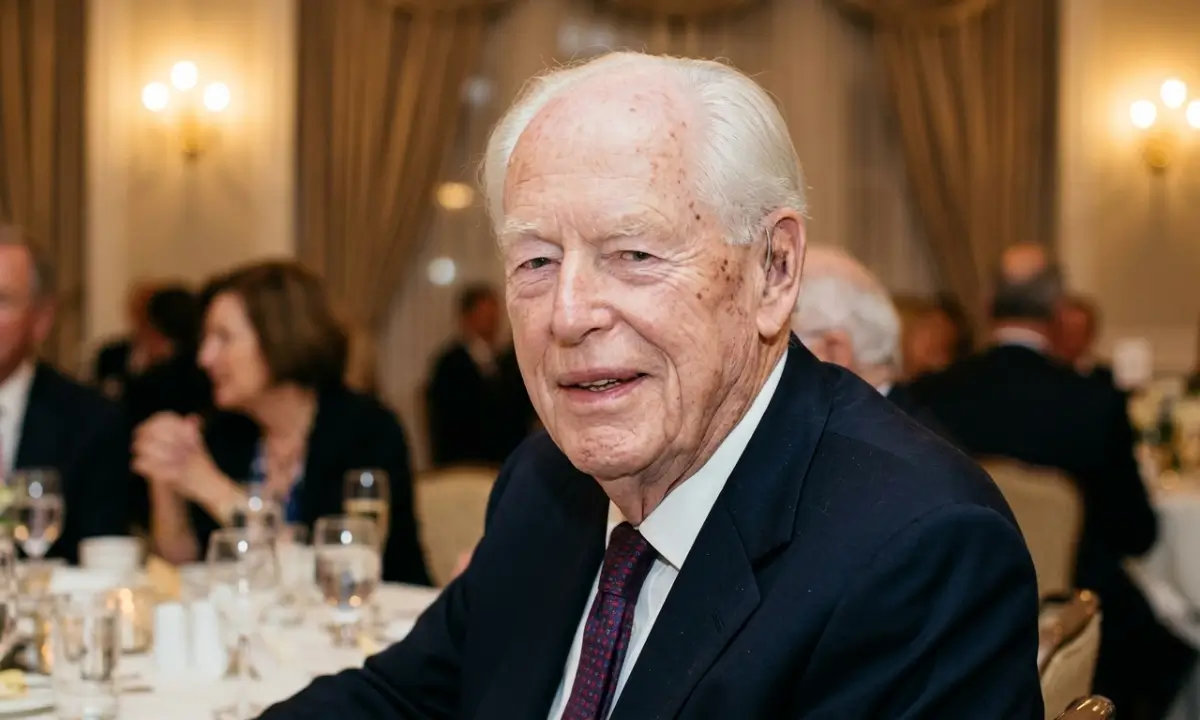
Hans Rausing Net Worth is often discussed as a single enormous figure, but the number tells only part of the story. His wealth began with a family packaging business, grew through decades of commercial expansion, and later supported charitable work in fields including medicine, human rights, culture and the environment. Because public estimates combine personal and family wealth—and do not provide a complete inventory of privately held assets—the figure should be read as an informed estimate, not a verified balance sheet.
Hans Rausing Net Worth at a glance
Forbes estimated the fortune of Hans Rausing and his family at US$12 billion in 2019. Converted using an approximate 2019 exchange rate, that is about €10.7 billion. The estimate refers to the family fortune, rather than a separately audited figure for Hans Rausing’s individual estate. He died in August 2019, aged 93.
| Asset or wealth component | Estimated value in euros | What the figure represents |
|---|---|---|
| Hans Rausing and family fortune | About €10.7 billion | Approximate conversion of the 2019 US$12 billion estimate; family wealth, not an audited personal estate total |
| Reported sale of Hans’s Tetra Pak stake | About €6.2 billion | Approximate conversion of the widely reported US$7 billion 1995 sale price |
| Published British probate estate figure | About €1.4 million | Reported net UK probate amount; excludes property and Swedish assets, so it is not a complete measure of his wealth |
The table brings together three numbers that refer to different things. The family-wealth estimate is the broadest measure; the 1995 sale price is a historical transaction; and the British probate figure captures only the assets included in a specific UK filing. They should not be added together or treated as interchangeable.
That distinction is central to understanding Hans Rausing Net Worth. The public estimates speak to a family fortune shaped by business ownership and investments. Probate records, by contrast, can reflect a much narrower legal estate in one jurisdiction. A modest probate total therefore does not establish that a person had only that amount in total assets.
The business behind the fortune
Hans Rausing was the son of Ruben Rausing, who founded the company that became Tetra Pak. Hans joined its leadership as the enterprise developed from a Swedish packaging operation into an international business. Tetra Pak’s rise was not simply a story of selling cartons: it depended on linking packaging design, filling equipment and food-processing technology into a system that helped manufacturers move liquid foods to consumers efficiently.
That system helped change how products such as milk could be packaged, stored and distributed. Lightweight cartons offered a practical alternative to heavier glass containers in many settings, while aseptic technology enabled some products to remain shelf-stable without refrigeration before opening. Those innovations had particular commercial value where long transport distances, retail infrastructure or storage conditions made conventional distribution more difficult.
The strategic insight was broader than any one package shape. Tetra Pak’s commercial model connected the container to the machinery used to fill it and to the processes that customers relied on. Once a manufacturer adopted the equipment and production system, packaging became part of a long-term industrial relationship rather than a one-off purchase. That helped build scale and made the company’s growth less dependent on the appeal of a single product.
Hans Rausing served as chief executive for decades and later held senior leadership roles at Tetra Pak and Tetra Laval. He was CEO from 1954 to 1985 and chairman of the group board from 1985 to 1993. He left the family business in the 1990s, and in 1995 he and his family sold their interest in Tetra Laval.
The 1995 decision that changed everything
The most consequential financial turning point came in 1995, when Hans sold his stake to his brother Gad. The deal was widely reported at about US$7 billion, equivalent to roughly €6.2 billion using the approximate 2019 dollar-to-euro rate applied here. The sale transformed a concentrated holding in one operating group into wealth that could be managed and invested across a wider range of assets.
That change helps explain why estimates of Hans Rausing Net Worth continued to reflect substantial wealth long after he ceased to own a direct stake in the packaging group. Selling a major business interest does not make its value disappear; it changes the form of the asset. A private-company stake becomes liquid proceeds, which can be invested, transferred, donated or held through structures that are not fully visible in public records.
For a founder or heir, such a sale also reduces exposure to risks concentrated in one business. A packaging company may face shifts in regulation, materials costs, technology and customer demand. Reinvesting the proceeds can spread that risk across other holdings. Public reporting does not reveal a complete portfolio for Rausing, so it would be misleading to claim that particular investments account for a specific share of his later fortune. The broader point is that the 1995 transaction marked a transition from industrial ownership to wealth stewardship.

Why the estimate needs careful reading
The phrase Hans Rausing Net Worth can imply that a single authoritative number exists. In reality, the most widely repeated public figure is an estimate for Hans Rausing and his family, not an audited statement of personal assets. Estimates of private wealth depend on valuations, ownership information and assumptions about liabilities—details that are often incomplete for families with private companies, trusts, property and cross-border holdings.
The reported British probate figure illustrates the problem. One account put the net UK estate at roughly £1.24 million, while noting that the sum excluded property and Swedish assets. That figure cannot be used as a substitute for the broader family-wealth estimate because it describes a different legal and geographic slice of the picture.
The responsible reading is therefore not that one number must be false and another true. Rather, each number answers a different question. The family-wealth estimate asks how large the fortune was judged to be; the sale price records what a particular business stake reportedly fetched decades earlier; and probate records identify assets dealt with in a specific legal process. These distinctions are important whenever wealth figures are repeated in headlines.
A fortune measured in more than ownership
The story of Hans Rausing Net Worth also raises a wider question: what does a great private fortune do after its owner leaves active business life? Rausing devoted time and money to philanthropy after leaving the company. His family said that more than £1 billion had gone to causes that included medical innovation and research, human rights, culture and the environment.
That scale of giving shifts the conversation beyond ranking one person among the world’s wealthy. Philanthropy can fund research and cultural work that may not attract enough conventional investment, while allowing donors to support priorities over long periods. It can also bring difficult questions: how should private donors set public priorities, how transparent should giving be, and how can recipients demonstrate that money leads to lasting results? Those questions apply to large-scale philanthropy generally, not only to the Rausing family.
A notable example connected with his legacy is the Hans Rausing Endangered Languages Project at the University of London. The project supports research, training and the archiving of languages at risk of disappearing. Such work may not produce the immediate, easily counted returns associated with a commercial enterprise, but it preserves knowledge and cultural records that could otherwise be lost.
This is one reason a net-worth story can have public importance. It can show how industrial wealth was created, but also how capital later influenced research, cultural preservation and charitable institutions. Hans Rausing Net Worth is therefore not merely a measure of accumulated money; it is a way into a larger discussion about the social reach and accountability of private wealth.
Future plans and the family legacy
Hans Rausing died in 2019, so he had no personal future business plans after that date. Any discussion of what comes next concerns the family’s continuing stewardship of its wealth and charitable commitments—not plans that can be attributed to him. His heirs and related family initiatives may carry elements of his legacy forward, but their decisions should be distinguished from his own.
For the family, the central long-term challenge is balancing preservation, responsible investment and giving. A fortune built through a successful industrial company can outlast the original business relationship by generations. Its influence then depends on governance: how decisions are made, how philanthropic outcomes are assessed and how future family members define their responsibilities.
The packaging industry itself continues to face questions around material use, recycling, food safety and environmental impact. Those issues give the Tetra Pak story a continuing relevance: the innovations that helped make food distribution more efficient must be judged alongside the environmental consequences and the industry’s efforts to improve packaging systems. The business legacy is not frozen in the era when Hans led the company; it remains connected to current debates about how to protect food, reduce waste and manage packaging responsibly.
The most useful conclusion about Hans Rausing Net Worth is not that a headline estimate settles the matter. It is that a family business, built into a global industrial system, created wealth on a scale that later supported significant charitable giving—and that public estimates only partially reveal how that wealth was owned, transferred and used. Hans Rausing’s legacy is best understood through both sides of that story: the commercial decisions that generated capital and the philanthropic choices that helped direct some of it beyond the family.
“Rausing Hans” may occasionally appear as a reversed search phrase, but the person at the centre of the story is the same Swedish industrialist: a leader who helped expand Tetra Pak, sold his stake in 1995 and later became known for philanthropy. The related phrase “Tetra Pak heir Hans Rausing” captures his family connection, while his own career shows that inheritance alone does not explain the company’s growth. His brother Finn Rausing is another member of the wider family story, but Hans’s public legacy rests on his own decades in business and the charitable work associated with his fortune. Hans Rausing Net Worth remains an estimate; the history behind it is the more durable story.

1 Comment
Pingback: Lakshmi Mittal Net Worth: Steel Fortune Explained - Celevo